Jarvis/HuggingGPT

Overview of JARVIS

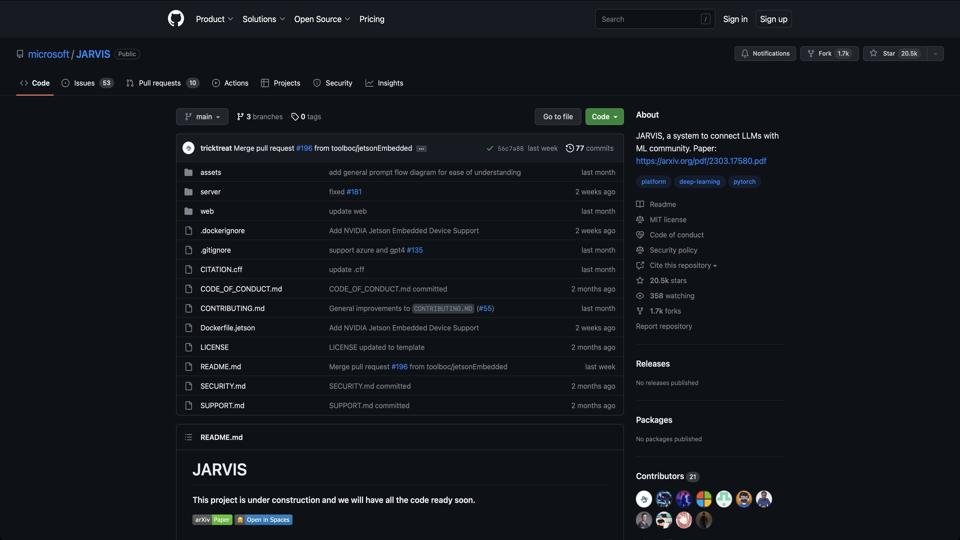
JARVIS is an open-source project developed by Microsoft, inspired by the AI assistant from the Iron Man series. It serves as a system that integrates large language models (LLMs) with multimodal models to plan, execute, and complete complex tasks. The tool leverages an extensible set of APIs and models, primarily from Hugging Face, to handle tasks involving text, images, audio, and more. You can find the official repository here. Released in 2023, JARVIS aims to create a collaborative AI ecosystem where models work together like a team to solve problems.

Key Features

  • Multimodal Task Handling: Supports integration with various models for text generation, image recognition, speech-to-text, and other modalities.
  • Task Planning and Execution: Uses LLMs to break down tasks into subtasks and delegate them to appropriate models or tools.
  • Extensibility: Easily add new models or APIs via Hugging Face’s ecosystem, making it highly customizable.
  • Open-Source and Community-Driven: Licensed under MIT, with active contributions on GitHub.
  • API Integration: Compatible with tools like OpenAI’s GPT models, though it emphasizes open-source alternatives.

Pros

  • Highly innovative approach to AI collaboration, reducing reliance on single models for complex tasks.
  • Strong focus on open-source tools, promoting accessibility and cost-effectiveness.
  • Excellent documentation and examples on GitHub, making it easier for developers to get那么 and get started.
  • Potential for real-world applications in automation, research, and AI development.

Cons

  • Setup Complexity: Requires technical expertise to install and configure, including dependencies like Python, PyTorch, and access to GPU resources for optimal performance.
  • Resource-Intensive: Running multimodal models can be computationally expensive, demanding high-end hardware.
  • Early-Stage Development: As a relatively new project, it may have bugs or incomplete features, and the ecosystem is still evolving.
  • Dependency on External Services: Relies on Hugging Face’s API, which could introduce latency or costs for heavy usage.

How to Use JARVIS

  1. Clone the repository: git clone https://github.com/microsoft/JARVIS.git
  2. Install dependencies: Run pip install -r requirements.txt in a Python environment (3.8+ recommended).
  3. Configure models: Set up API keys for Hugging Face or other services in the config files.
  4. Run examples: Use provided scripts to test tasks like image captioning or question answering.
  5. Extend it: Add custom models by modifying the models/ directory and updating the planner.

For detailed instructions, refer to the README.md on GitHub.

Conclusion

JARVIS is a promising tool for AI enthusiasts and researchers looking to build advanced, task-oriented AI systems. Its modular design fosters innovation, but it may not be suitable for beginners due to its technical demands. If you’re into AI orchestration and have the resources, it’s worth exploring—rated 4.5/5 for its potential impact on the field.

Join the AI revolution!
Building the world's finest AI community is no walk in the park, do you want
to be a part of the change? Let's work faster, smarter and better!